
Bones in Children
Children have more porous, less dense bones than adults. They have larger Haversian canals, which are the longitudinal tubes within the bone that contain blood vessels and nerves. The periosteum, which is the membrane that surrounds the bone, is stronger than in adults.
Overall, bones in children are more flexible but less strong than in adults. They bend more before breaking, which can lead to greenstick and buckle fractures. They also have a better blood supply, which means fractures heal faster.
Bone remodelling is the process by which bone tissue is removed from areas of low mechanical stress and deposited in areas of high mechanical stress, allowing bone to adapt for optimal function. Bones in children have a high capacity for remodelling, helping with the healing process after a fracture.
Growth Plates
Growth plates (epiphyseal plates) are found in the bones of children, between the epiphysis and the metaphysis. They are made of hyaline cartilage. The epiphysis and the metaphysis fuse during adolescence, and the growth plates become the epiphyseal lines.
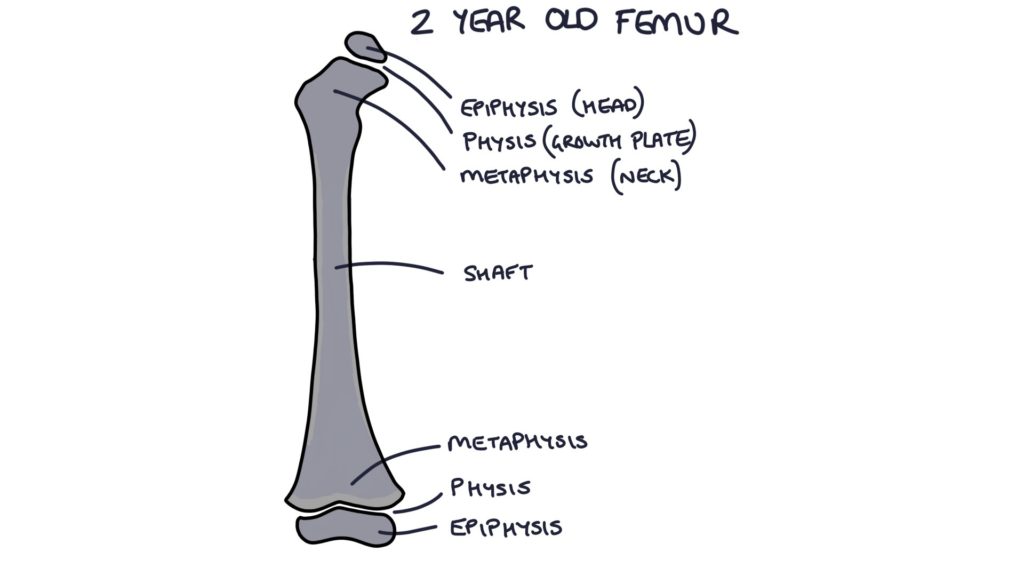
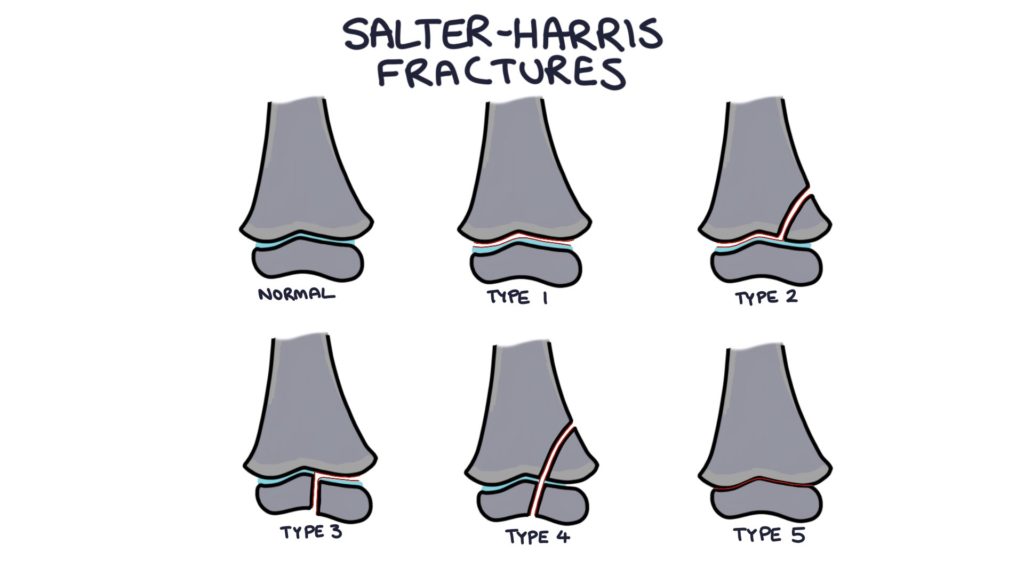
Fractures through the growth plate can disrupt growth in that bone. Growth plate fractures are graded using the Salter-Harris classification. Fractures involving the growth plate or articular surface require specialist input and often surgical management.
Use the SALTR mnemonic to remember the types:
- Type 1: Straight across
- Type 2: Above
- Type 3: BeLow
- Type 4: Through
- Type 5: CRush
Types of Fracture
- Buckle (torus)
- Transverse
- Oblique
- Spiral
- Segmental
- Comminuted
- Greenstick
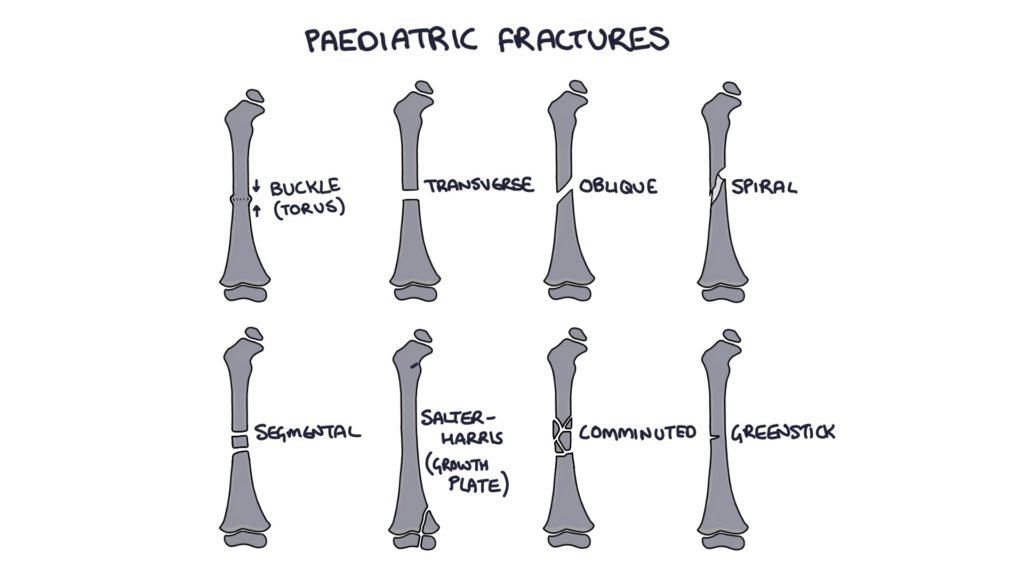
Children are more likely to have greenstick fractures, where only one side of the bone breaks while the other side of the bone stays intact.
Children are more likely to have a buckle fracture (or torus fracture) due to weaker resistance to compression.
Management
Management of fractures in children involves:
- Analgesia for pain (e.g., paracetamol and ibuprofen if mild-moderate, with opioids if moderate-severe)
- Neurovascular assessment (e.g., pulse, capillary refill and nerve function assessment)
- X-rays to establish the diagnosis
- Reduction and immobilisation
The first principle is reduction of the fracture to achieve the normal mechanical alignment by either:
- Closed reduction via manipulation of the fracture
- Open reduction via surgery
The second principle is to immobilise the fracture to provide relative stability for a period of time, allowing healing. This can be done by fixing the bone in the correct position while it heals. There are various ways the bone can be fixed in position:
- Casts, splints or backslabs
- K wires
- Intramedullary wires
- Intramedullary nails
- Screws
- Plate and screws
It is important to keep safeguarding in mind when children present with fractures, and ask whether the story matches the injury. When there is doubt, a senior clinician should be involved and a safeguarding referral should be considered.
TOM TIP: Certain pain medications are not routinely used in children. Codeine and tramadol are avoided in younger children as there is unpredictability in their metabolism, so the effects vary too greatly. Aspirin is avoided in children under 16 due to the risk of Reye’s syndrome (except in very specific circumstances, such as Kawasaki disease).
Complications
Complications of fractures in children include:
- Growth-plate injuries, with impaired growth
- Malunion (healing in abnormal positions)
- Neurovascular injury (damage to nerves or blood vessels)
- Compartment syndrome
Last updated June 2026
Now, head over to members.zerotofinals.com and test your knowledge of this content. Testing yourself helps identify what you missed and strengthens your understanding and retention.
